
WalkMe alternatives in 2026 for SaaS onboarding and employee training
Frigade guides people in your SaaS product, Salesforce, Workday, and internal systems. Compare generated guidance with authored flows, including pricing, automation, and employee training.

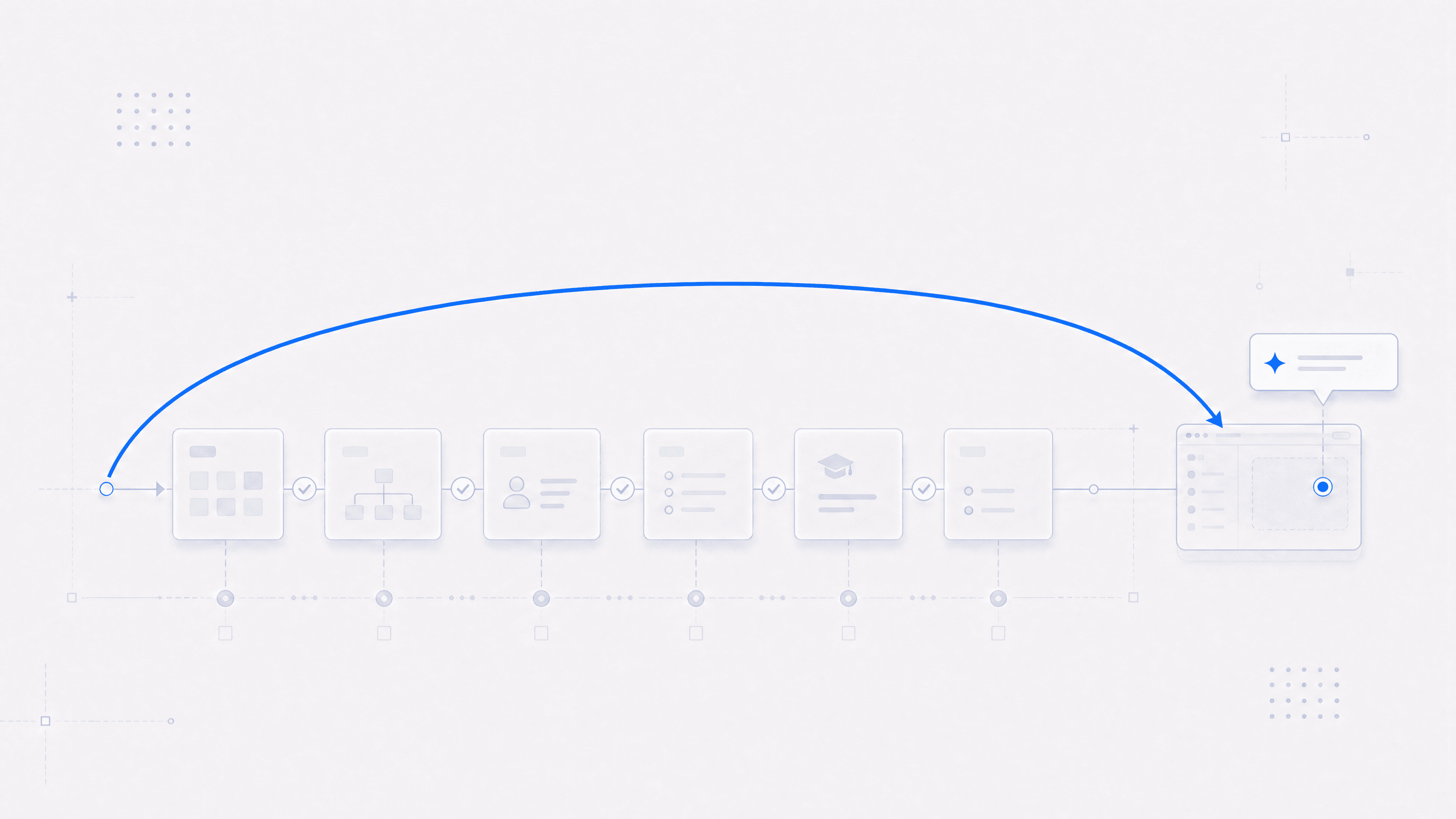
Frigade Assistant is a WalkMe alternative for guiding people through both your own SaaS product and applications such as Salesforce, Workday, and internal systems. It learns each application by using it, then answers questions and generates walkthroughs for the task someone is trying to finish.
We make Frigade, so that's the approach we favor. The choice is whether you want an assistant to generate guidance from product knowledge or want your team to author the flows. A company-wide training program may also need reporting and publishing controls alongside that guidance.
The three jobs WalkMe takes on, and the modern alternative for each
For a SaaS app you own, Frigade can answer customer questions and walk people through setup. Appcues, Userpilot, and Pendo also provide in-app onboarding tools. Frigade Engage is our option when you want to build those experiences in React.
For third-party apps, Frigade learns the software your employees use and helps them work in it. Whatfix supports guidance in employee applications, and Pendo offers guides through its browser extension.
For an employee training rollout, Frigade can teach people tasks inside those applications. If the program also requires formal completion records or reports across departments, those requirements belong in the comparison too.
At a glance: WalkMe vs. the modern alternatives
The table summarizes guidance, automation, and the work involved in keeping them current. Pendo, Userpilot, and Appcues have different plans; features named for one should not be read as applying to all three.
| Capability | WalkMe | Whatfix | Pendo / Userpilot / Appcues | Frigade Assistant |
|---|---|---|---|---|
| Tours on SaaS apps you own | In-app guides and tours | In-app Flows and tooltips | In-app onboarding flows | Generated tours from learned product knowledge |
| Tours on third-party apps (Salesforce, Workday, NetSuite) | Guidance on employee applications | Guidance on employee applications | Pendo: guides through its Launcher extension | Guides users in Salesforce, Workday and internal systems |
| Full enterprise change-management suite | Guidance, automation, administration and adoption analytics | Multi-app guidance, content management and reporting | Onboarding and engagement; Pendo also provides product analytics | In-app answers, training, generated guidance and actions; formal training administration is separate |
| Setup time | Request a timeline with the quote | Request a timeline with the quote | Install the product and author the flows | Agent learns each application; configure the assistant and review its guidance |
| Annual cost | Custom quote | Custom quote | Userpilot Starter: $3,588 annual equivalent at $299/mo; Pendo and Appcues paid plans: request a quote | Growth starts at $12,000 annual equivalent at $1,000/mo |
| Updates when product UI changes | DeepUI updates element mappings after UI changes | Auto Testing for web apps (Premium); Auto reselect is a support-enabled beta | Authored flows; maintenance features differ by product | Scheduled re-learning, with extra learning passes on request |
| Takes actions on the user's behalf | ActionBot and automated workflows | Automation within configured Flows | Appcues Flows 2.0 (beta): navigation, events and property updates | Enabled Skills and connected tools |
Prices checked October 7, 2026 against WalkMe, Whatfix, Pendo, Userpilot, Appcues, and Frigade. Annual equivalents multiply the published monthly rate by 12; they are not annual contract quotes. Userpilot Starter lists up to 2,000 monthly active users.
The action and maintenance entries reflect the documented features of WalkMe DeepUI and Appcues Flows 2.0, as well as the automation sources below. For more on Frigade and WalkMe, see our comparison page.
If you need tours on your own SaaS app
Frigade Assistant learns how your product works and uses that knowledge to generate a walkthrough when someone needs help. A customer can ask how to invite a teammate or change a setting, and get guidance from the screen they're on. You can also offer help through Suggestions, such as a prompt to connect an integration after an upgrade.
The work for your team is teaching the agent the product and reviewing its guidance. Frigade re-learns on scheduled passes, and you can request another pass after a release.
Authored flows are useful when you want to control the exact wording and order of an experience. A feature announcement or a standard welcome tour can benefit from that control. Appcues lets you build those flows on top of your product; Frigade Engage gives you React components for the same kind of deliberate authoring.
If you need tours on a third-party app you don't own
Frigade works in Salesforce, Workday, and internal systems. The agent learns each application the same way it learns a SaaS product you built: by using it. Employees can ask questions and get guidance inside the application they're working in.
That makes Frigade relevant when the problem is teaching people how to use software you didn't build. For example, a new sales hire might ask how to update an opportunity in Salesforce. The assistant can generate a walkthrough for that task instead of requiring your team to prepare a tour for it first.
Whatfix is also an option for this use case: its plans cover employee applications and multi-app guidance. Pendo supports extension applications for delivering guides on third-party websites.
If you need an employee training rollout
Frigade can provide the in-app training for employees using your own software or third-party applications. Someone learning an internal purchasing system can ask how to submit a request and get a walkthrough while doing it.
A formal training program can involve additional work, such as assigning courses, recording completion, and reporting progress to a department lead. Frigade's generated guidance addresses the task inside the application. If you need those administrative functions too, compare them explicitly rather than treating a walkthrough as the whole training program.
WalkMe's plans include adoption analytics and administration controls. Whatfix provides guidance analytics and reporting across applications. For onboarding inside a SaaS app, Appcues, Userpilot, and Userflow are also worth considering when you want to author the experience.
How to pick
Choose Frigade when you want people to ask questions and get guidance without your team writing every walkthrough. That applies to customers in your product and employees in Salesforce, Workday, or internal tools.
Choose an authored flow when the exact sequence is the point, such as an introduction everyone should see. A product can combine a planned welcome experience with an assistant that helps with the questions and tasks that come after it.
Why "AI" inside WalkMe isn't the same as an AI-native alternative
The useful distinction is how a walkthrough gets made. Frigade's agent learns the application firsthand and generates guidance from that knowledge. Your team doesn't need to define the steps of each tour. Enabled Skills also let the assistant complete supported tasks from the conversation.
WalkMe and Whatfix have automation too. ActionBot runs configured processes, and Whatfix supports automated steps within Flows. Whatfix also offers automated testing and element reselection automation in beta.
Being able to run a prepared workflow and being able to generate a walkthrough for a new question are different capabilities. When you compare products, ask for help with a task you haven't prepared a tour for. You can see how much of the answer comes from the system's understanding of the application.
The ProductOnboarding.com report on digital adoption platforms discusses these approaches in more detail.
FAQ
What is the closest WalkMe alternative for SaaS apps you own?
Frigade Assistant generates guidance from what it learns by using your product. Appcues, Userpilot, and Pendo offer in-app onboarding tools when you want to build the flows yourself. Frigade Engage is our option for authored experiences in React.
What is the closest WalkMe alternative for overlaying third-party apps like Salesforce or Workday?
Frigade Assistant works in Salesforce, Workday, and internal systems as well as your own SaaS product. It learns each application and guides people through their tasks. Whatfix is another option for employee applications, and Pendo supports guides through its Launcher extension.
How long does a WalkMe rollout take, and how do alternatives compare?
Rollout time depends on the applications and workflows you need to support. With Frigade, the agent learns the application and generates guidance, so your team does not have to author each tour. Installation and review still need to happen; we do not promise a fixed rollout time for every application.
Can Frigade replace WalkMe entirely?
Frigade can replace WalkMe for in-app answers and guidance in your SaaS product, third-party applications, and internal systems. If you also use WalkMe for training records, publishing controls, or cross-application reporting, compare those requirements separately. They are distinct from helping someone complete a task in an application.