
Introducing Frigade AI: Intelligent product assistance
Today we're launching Frigade AI: an intelligent product assistant that learns your software by using it. A new product alongside the SDK that already powers our existing customers.

Our Journey
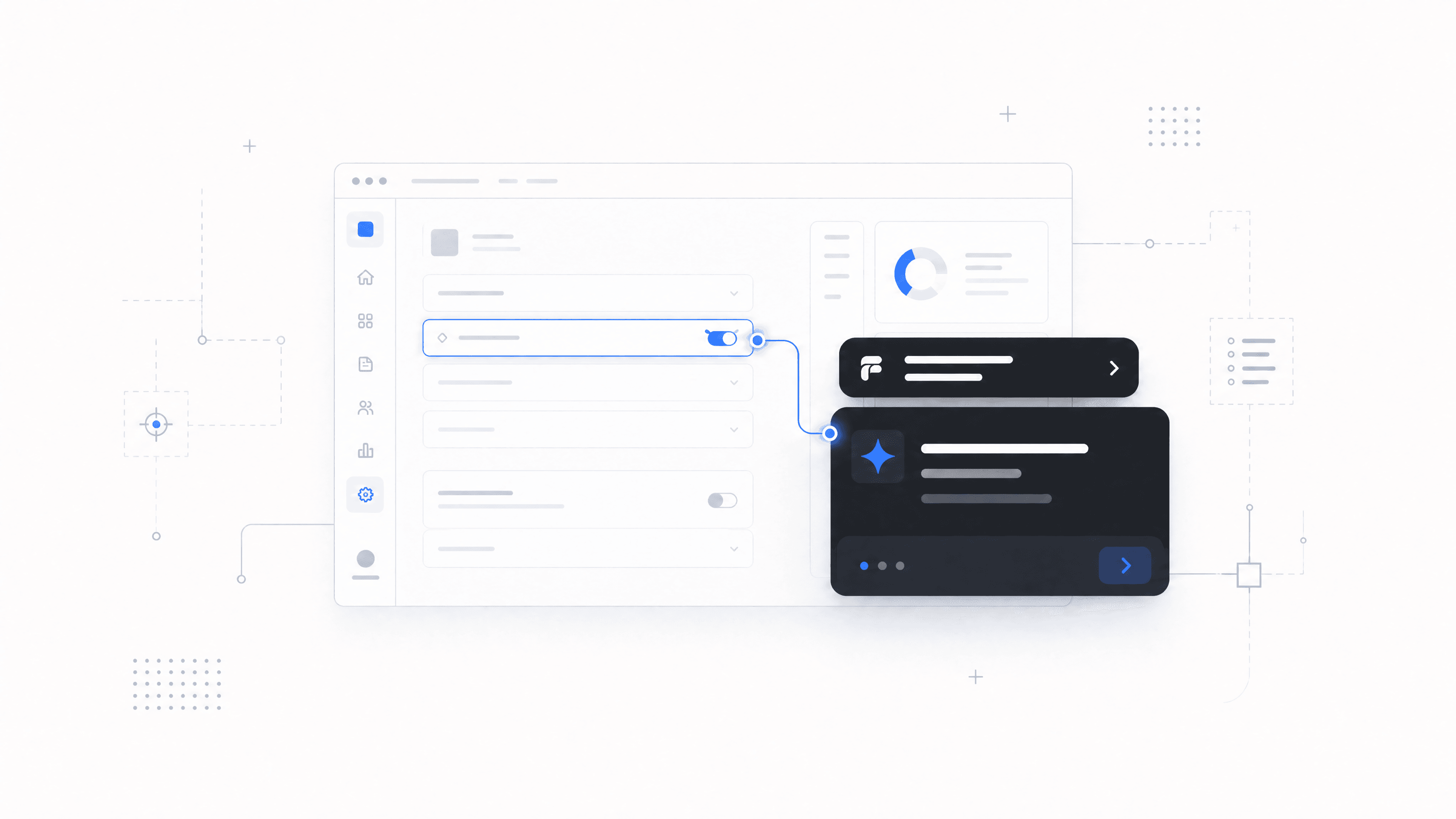
Frigade began with a simple observation while working at LinkedIn: a powerful internal onboarding platform dramatically improved how teams built and tested user engagement. We set out to bring this capability to all companies, eliminating the need for expensive in-house solutions.
Today, Frigade is the developer tool of choice to build structured onboarding experiences - product tours, registration flows, and checklists. Customers like Productboard, Orb, and Merge value our platform for its customization, flexibility, and quality compared to no-code alternatives.
The Limitations of Structured Onboarding
Working closely with customers revealed opportunities that our current platform was not solving. While structured flows effectively guide users through planned journeys, we identified persistent challenges:
- Users need assistance beyond pre-planned paths
- Engineering teams face resource constraints
- Product changes break existing user journeys
- Support requirements continue after initial onboarding
These challenges required a fundamentally different solution.
Introducing Frigade AI
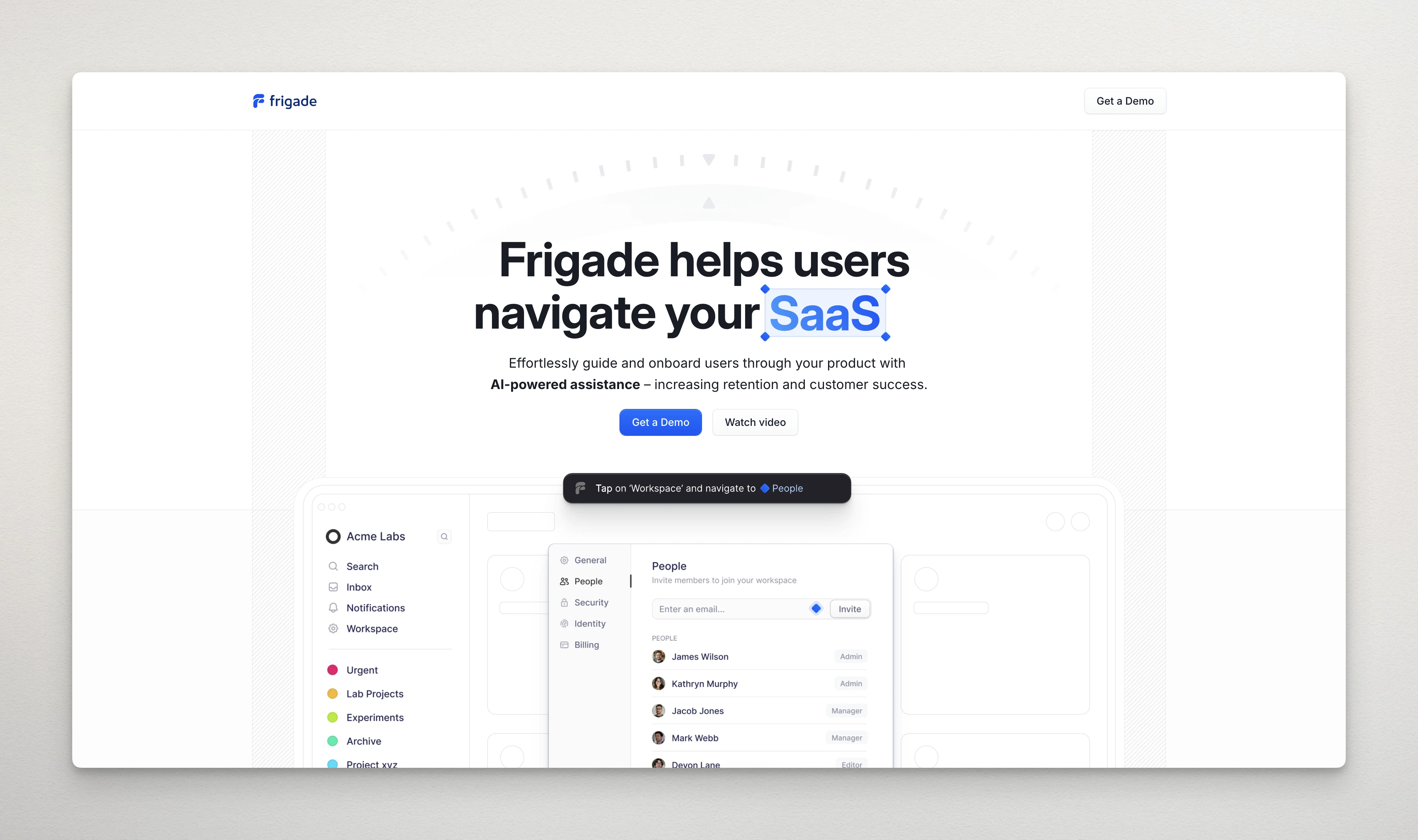
Today we're launching Frigade AI - an intelligent product assistant that guides users through your product interface.
Unlike conventional AI copilots, Frigade AI understands your product's context and user context to deliver personalized assistance:
- Guides users through any flow step-by-step, in context of your product
- Takes actions directly on users' behalf to make their experience effortless
- Answers open-ended questions about your product
- Requires minimal engineering setup to install and train
Our AI learns by interacting with your product and analyzing your documentation. It updates automatically as your product evolves, eliminating manual updates and saving countless configuration hours.
How Our Products Work Together
For existing customers, our platform continues to provide structured experiences for key workflows, while Frigade AI fills gaps with dynamic, on-demand assistance.
New customers can choose what works best: our SDK for complete control, our AI assistant for automated guidance, or both working together.
We remain fully committed to our existing platform. Frigade AI expands our product lineup, creating exceptional user experiences when combined with our core offering.
Frigade AI vs. other digital adoption platforms
Most digital adoption platforms (DAPs) on the market today are built the same way, a no-code editor where someone on your team authors tours, checklists, and tooltips by hand. The flow works until your product changes. Then someone has to update it.
Frigade AI works differently. It is an autonomous AI agent that learns your product the way a real user would, then guides users through real workflows on demand. There is no authored flow to maintain because there is no authored flow.
Here is how Frigade compares to the main competitors in the digital adoption space:
| Feature | Pendo | WalkMe | Userpilot | Frigade |
|---|---|---|---|---|
| Onboarding flows and product tours | ✅ Yes | ✅ Yes | ✅ Yes | ✅ Yes |
| AI-generated tours that self-repair as the product changes | ❌ No | ❌ No | ❌ No | ✅ Yes |
| Product analytics built in | ✅ Yes | ✅ Yes | ✅ Yes | ✅ Yes |
| AI in-app assistant | ❌ No | ⚠️ Limited | ❌ No | ✅ Yes |
| Self-learns your product | ❌ No | ❌ No | ❌ No | ✅ Yes |
| Adapts automatically when your product changes | ❌ No | ❌ No | ❌ No | ✅ Yes |
| Takes actions on a user's behalf | ❌ No | ❌ No | ❌ No | ✅ Yes |
| Self-hostable | ❌ No | ❌ No | ❌ No | ✅ Yes |
A short read on who each platform is best for:
- Pendo: Established analytics-led DAP. Best fit for teams that have already standardized on Pendo and want one platform for analytics and onboarding. Every tour, checklist, and tooltip has to be authored and updated manually whenever the product changes, on top of a closed-source overlay and opaque pricing.
- WalkMe: Enterprise-first DAP with a long-running sales motion. Best fit for orgs with deep budgets and IT-driven rollouts. WalkMe requires manually updating tours by hand whenever the product changes, and the WalkMe AI features sit on top of the same author-once flow model underneath.
- Userpilot: Mid-market SaaS flow-builder leaning into product analytics. Best fit for growth teams that want flows and tag-based analytics without engineering involvement. Tours and checklists have to be re-authored manually every time the underlying product changes.
- Frigade: AI-native in-product assistant plus traditional engagement tools through Frigade Engage. Best fit for modern SaaS teams and enterprises that want guidance to keep working as the product ships, without anyone updating a tour.
Common questions about digital adoption platforms
What is a digital adoption platform?
A digital adoption platform (DAP) is software that sits on top of a SaaS product to help users learn and adopt its features. Most DAPs offer authored product tours, in-app guides, checklists, and analytics. Frigade AI is an AI-native version of the same category: instead of someone authoring the tours, an autonomous AI agent learns the product and guides users on demand.
What's the difference between an in-app AI assistant and a traditional product tour?
A traditional product tour is a sequence of steps someone on your team authored by hand. It shows everyone the same path and breaks when the underlying UI changes. An in-app AI assistant takes a question from a specific user, looks at the actual product, and walks that user through the workflow that matches their intent right now. It adapts to what the user is trying to do and to whatever the product looks like today.
How is Frigade AI different from Pendo, WalkMe, and Userpilot?
Pendo, WalkMe, and Userpilot are all flow-builders at heart. Their value is the editor that lets a non-engineer author a tour. Frigade AI doesn't have an editor because there are no tours to author. The Assistant uses your product on its own and answers user questions based on the current UI. Flows don't rot because there are no flows.
Can DAPs adapt automatically when the product changes?
Traditional DAPs like Pendo, WalkMe, and Userpilot cannot. Every authored tour, checklist, and tooltip stays exactly as someone wrote it until a human updates the flow. When you ship a UX change, the tours go stale. Frigade can: it re-learns the product as it changes and updates its guidance without anyone editing a flow.
Does Frigade support on-prem hosting?
Both Frigade Assistant and Frigade Engage support self-hosting on Enterprise plans, with customers running Frigade on their own infrastructure when their security posture requires it.
How do digital adoption platforms typically charge?
Pendo and WalkMe are quote-only enterprise contracts with opaque pricing. Userpilot publishes starting prices (typically $250 to $400 per month) and tiers up by monthly active users. Frigade plans start at $1,000 per month on the Growth tier with usage-based scaling, and Enterprise plans add self-hosting and SSO.
Looking Toward the Future
Frigade AI transforms how users experience software. Today, Frigade AI can make sure your users never get stuck in your product, increasing retention and customer success.
AI agents are starting to operate your product on your users' behalf, and Frigade is how they get good at it. Frigade becomes your product's expert inside those agents. That is the Frigade Assist API: add Frigade to an agent you already built with one call, and it guides any user through any workflow, right inside your own agent.
Experience Frigade AI
Ready to level up your user experience with Frigade AI? Schedule a demo with our team today.